
Heritage
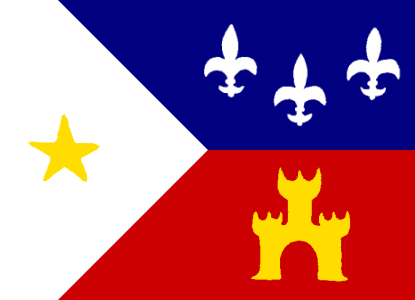
Acadiana, the Cajun heartland, is so rich with culture, it could practically be another country. We have our own language, music, humor and we even have our own flag. Although there is enough content about Cajun history to go on for weeks, here’s a quick introduction to our wonderful, unique culture.
Our Flag
Acadian-Cajun.com says this of our flag:
Our Language
Cajun french is a dialect of the French Language. While it is rooted in Parisian french, there are distinct differences. While most of the “baby boomer” generation’s first language was Cajun French, most of the younger generation, unfortunately, do not speak it anymore. The The Council for the Development of French in Louisiana ( CODOFIL) states the following on their website:
Perhaps in part to CODOFIL’s efforts, there has been a recent revival of interest in Cajun french. The Department of French Studies at Louisiana State University has put together a Cajun-French glossary that you can read here. You can also find out more about Cajun French preservation at ActionAcdienne.org
One of the creators of RealCajunRecipes.com, Chrissy, recently purchased a book and audiobook on CD called “Cajun Self-Taught” from FloydsRecords.com. The 500-page book was written by a 90 year old Reverend named Rev. Daigle. You can read more about the book and her adventures on the RealCajunRecipes.com blog. Also, you can hear a sample of the wonderful audio book companion to the CD below (Windows only).
Our History
The Late Floyd Sonnier’s Website gives a short summary of our Cajun History
The word “Cajun” did not come into being until sometime in the late 18th Century and is strictly a South Louisiana word. Up to World War II the word “Cajun” was somewhat of a source of embarrassment and ridicule. This came about because it suggested “a poor and uneducated person who spoke mostly French and some, if any, broken English.” It was not until the late 1940’s and early 1950’s that the Cajun population realized that this negative attitude was causing the eradication of their culture and the lost (sic) of their identity as an ethnic group. Through the efforts of many concerned people and organizations, a movement was designed to turn the negativism (sic) around into positive thinking and encourage proud feelings about the history and culture of their ancestors and the preservation of their French language. The heart of the Cajun culture is its language. This is on-going.
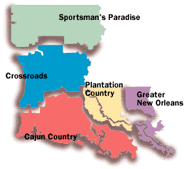
The 22 parishes designated by the Louisiana congress as “Cajun Country” is also known as Acadiana. There’s a great story behind how the term Acadiana was coined. Click here to read it and to see a list of the nearly 700 towns and communities that make up this area.
Our Food
Of course most people know us for our food. Although most people think “insanely spicy!” when they think of Cajun food, we prefer to think of our cuisine as more seasoned than peppered. Cajun imitation food found in other parts of the United States is sometimes even too hot (yet bland) for the poor misplaced Cajuns who order it looking for home cooking. Now, thats not to say that our food doesn’t have a kick! Our state is represented all over the world by the world-famous Tabasco Pepper Sauce which gives a yummy kick to everything from eggs to gumbo.
Countless Cajun meals contain the “Cajun Trinity” which is composed of onions, bellpeppers and celery. Almost every meal is also cooked in a black cast iron pot. This pot is usually passed down from generation to generation. We recommend that you invest in a black, cast iron pot when cooking dishes found at RealCajunRecipes.com
Our Art
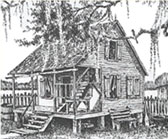
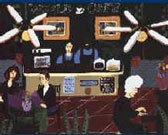
Traditionally, Cajun Art depicts many aspects of Cajun Culture, including the plight of the Acadians and Mardi Gras. However, in recent times, we have seen instances of Cajun Art like Rodrigue’s Blue Dog appearing in many pop culture magazines and advertisements. Check out Cajun Art items at Cajun Village Online.
Some examples of Cajun Art:

Our Music
Cajun music is integral to Cajun culture. Intertwined with popular music, Cajun music is performed and played at almost every celebration from proms to weddings. You can enjoy Cajun music from the comfort of your computer desk by following one of our links:
Our Festivals
A lot of people are under the assumption that Mardi Gras is only celebrated in New Orleans, but in fact, almost every town in South Louisiana has their own Mardi Gras celebration. Many towns triple in population on Mardi Gras day. In Louisiana, there’s a festival for almost everything, ranging from Bastille Day Celebration in Kaplan, to the Zydeco and Blues Festival in Mamou.
Visit our festivals page to find out more!
Our Humor
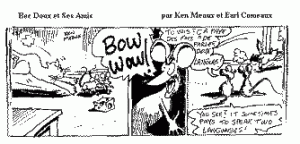
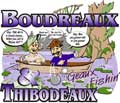
We’ve got some knee-slapping humor for you. Although most of our home-grown jokes center around a rather unintelligent pair of friends, Boudreaux and Thibodeaux, one of the funniest things we’ve seen about Cajun culture is an email forward entitled “You know you’re from Louisiana if…” So much of it is true.
If you’d like to know more or would like to help preserve Cajun heritage, please visit LA Folk Roots.org